
American Standard AC Repair & Installation in Boulder City: A Homeowner’s Guide
Most American Standard warranty claims we see fail in the Mojave not because of the equipment, but because the system was charged with refrigerant specs written for Phoenix’s humidity instead of Boulder City’s dry heat. American Standard builds solid machines. What goes wrong here usually traces back to how the unit was installed and set up for this desert, not the brand on the cabinet. If you’d rather not sort through charge charts and model numbers on your own, call (844) 312-0133 and we’ll take a look.
This guide is for the homeowner who has an American Standard unit, plans to stay in the house, and wants to know what to ask before signing anything. We’ll cover the failure patterns that actually show up in Boulder City, how the parts warranty works in practice, and the one installation choice that separates a 12-year unit from an 18-year one.
Why Boulder City Heat Is Hard on Any Brand, American Standard Included
Boulder City runs hotter and drier than the Las Vegas Valley floor most summer afternoons, and that combination stresses an air conditioner in specific ways. The compressor runs longer cycles at higher head pressure. The outdoor fan motor works harder to reject heat into 115°F air. And the control board sees more thermal cycling in a single season than a coastal unit sees in three.
Dry heat has a second effect that surprises people: the system pulls very little moisture out of the air, so it runs closer to its rated capacity but with less of the latent cooling load it was designed around. American Standard equipment handles this well when it’s set up correctly. When it’s set up for a humid climate, it short-cycles, overworks the metering device, and slowly loses efficiency you never notice until the electric bill climbs.
What we’ve found in our experience around Boulder City:
- Units installed with sea-level or Valley-floor charge specs tend to run a few degrees off on superheat and subcooling, which strains the compressor over time.
- Outdoor coils in our dust and wind load up faster than in wetter climates, cutting airflow and raising head pressure.
- Attic and garage-mounted air handlers see brutally high ambient temperatures, and that’s where a lot of the wear shows up first.
If your system is already struggling, our AC Repair & Installation in Boulder City page covers what a proper diagnostic visit includes.
AccuLink Communicating Systems: Why Certification Matters Before You Schedule
American Standard’s AccuLink communicating platform lets the indoor and outdoor units talk to each other, adjusting airflow and staging for efficiency. It’s genuinely good equipment. It’s also picky, and it needs a technician who knows that specific platform to install it, configure it, or diagnose a fault.
Here’s the part most homeowners don’t hear: a technician can be excellent on a standard single-stage Bryant or Carrier system and still not be trained on AccuLink commissioning. The control wiring, the board setup, and the fault codes are their own world. Put the wrong person on it and you get a system that runs but never hits its rated efficiency, or one that throws codes nobody can interpret.
How to verify before you schedule:
- Ask directly whether the technician is trained on the AccuLink communicating platform, not just “American Standard.”
- Ask if they carry the proprietary communicating thermostat and can commission it, or if they’ll fall back to a generic thermostat.
- Ask what happens if a board fails: do they source the correct part, or swap in a universal control that defeats the communicating function?
A straight answer to those three questions tells you more than any review. Our technicians are trained across nine major brands, including American Standard and Bryant, and we’ll tell you honestly if a job is outside what we handle.
The Capacitor and Contactor Pattern in Boulder City Summers
If your American Standard unit fails in July or August, there’s a decent chance it’s a capacitor or contactor. These are the two most common heat-related failures we see in Boulder City, and it’s not bad luck. Capacitors are temperature-sensitive components living inside a metal box sitting in full sun at 115°F. They degrade. Contactors pit and stick from the repeated high-current inrush of long compressor cycles.
The pattern is predictable enough that we think of it in two columns:
- Reactive: the unit quits on the hottest afternoon, you’re without cooling for a day or more, and you pay an emergency diagnostic on top of the part.
- Proactive: a technician tests capacitor microfarads and inspects the contactor during a seasonal tune-up, replaces a weakening part before it fails, and you avoid the worst-timed breakdown of the year.
Proactive is cheaper in dollars and far cheaper in aggravation. A failed capacitor in a Boulder City heat wave means a house that climbs past 90°F indoors by mid-afternoon, which is a real health concern for older homeowners. Our Fireside Heating & Air Co. Boulder City home page lists our tune-up offer and how a seasonal visit works. Worth noting: we’re upfront that our technicians aren’t paid on what they sell, so a tune-up report reflects what the system actually needs.
How the American Standard Parts Warranty Works in Practice
Most American Standard residential units carry a 10-year limited parts warranty on major components when the equipment is registered. That last part is the catch. The registration window is typically 60 days from installation, and if it slips by, the default coverage usually drops to a shorter term and the homeowner never knows it happened until a compressor fails.
What the parts warranty does and doesn’t cover:
- Covers: the compressor, condenser and evaporator coils, control boards, and other listed components, replaced at no charge for the part itself.
- Doesn’t cover: labor, refrigerant, diagnostic fees, or any damage from a bad install or incorrect charge.
In practice, the warranty is only as good as the paperwork behind it. Keep your registration confirmation. If you bought the house or inherited a system, a technician can often look up the serial number and tell you whether it’s registered and how much coverage remains. That’s a five-minute check that can save you thousands. We’ll run it for you as part of a diagnostic visit, no charge for a second opinion on any written estimate you’ve received elsewhere.
What a Correct Refrigerant Charge Looks Like at Boulder City’s Elevation and Dry Heat
Boulder City sits around 2,500 feet, and our air is bone-dry. Manufacturer charge charts are typically built around sea-level conditions and a standard humidity band. Set an American Standard unit to those numbers here and it’ll run undercharged. The technician has to charge by superheat and subcooling on the actual system in this actual climate, not by the sticker.
What we check on a proper charge:
- Superheat and subcooling measured against the unit’s specific target, not a generic chart.
- Ambient and indoor conditions at the time of measurement, because a charge set at 95°F behaves differently than one set at 115°F.
- Line set length and elevation change, which affect the correct charge on a split system.
- Filter and coil condition first, since a dirty coil skews every reading and no charge fixes a restricted coil.
An undercharged system runs long cycles, ices the indoor coil on cooler days, and beats up the compressor. It’s the quiet failure that costs you an early replacement. Get the charge right the first time and the unit performs the way it was built to.
The One Installation Decision That Decides 12 Years or 18
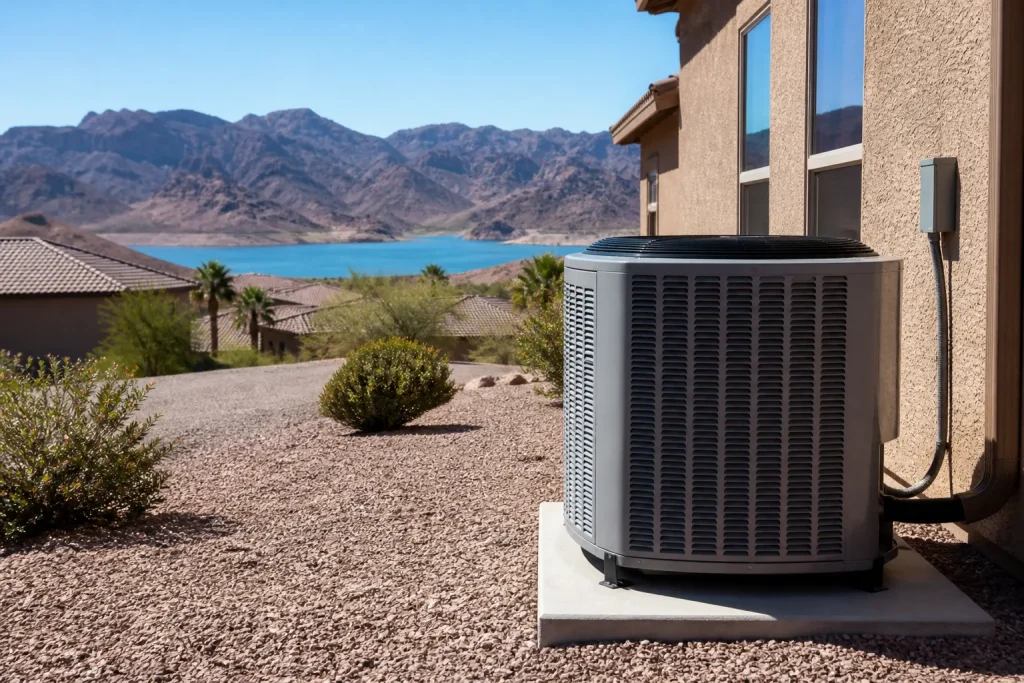
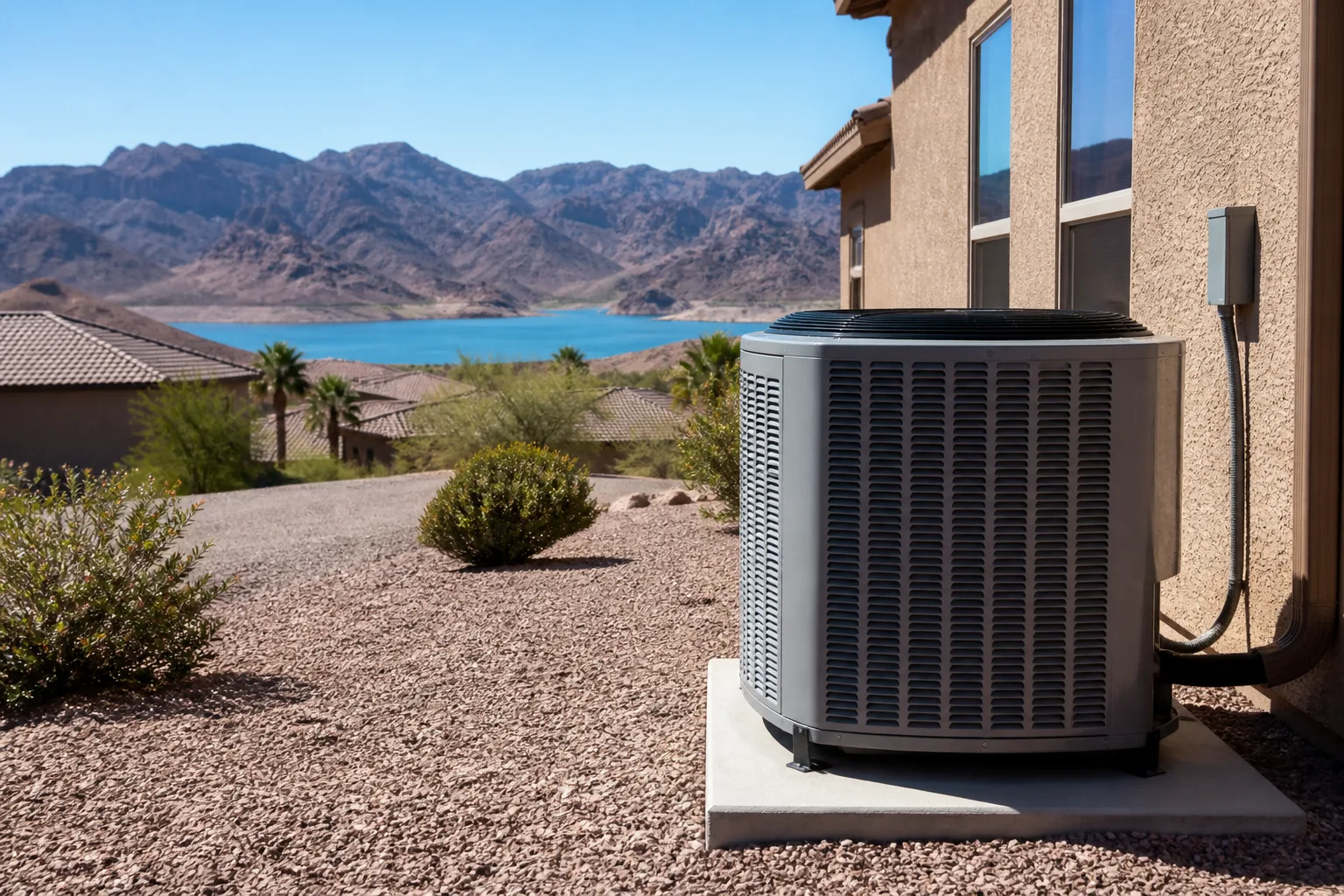
Equipment pad placement. It sounds boring, and that’s exactly why it gets rushed. On an American Standard condenser in Boulder City, where it sits and how much clear space surrounds it determines how hard the unit has to work for its whole life.
Get it right and the compressor, fan motor, and coil last as designed. Get it wrong and you’re replacing parts and eventually the whole system years early. What a correct pad placement looks like here:
- Full sun avoided where possible. A shaded west or north side runs cooler and cycles less than a pad baking on a south wall.
- Clearance on all sides. Manufacturer minimums are a starting point, not a target. A unit boxed against a fence or wall recirculates its own hot air.
- A pad that stays level. Our soil shifts with the dry-wet cycle, and a tilting pad puts stress on the refrigerant lines and cabinet.
- Room for service. A unit jammed into a corner makes every future repair harder and more expensive.
We pulled a condenser out of a tight side yard in Boulder City last summer that had been baked against a block wall for eleven years with barely a foot of clearance. The compressor was done. Two feet of breathing room would likely have bought it another five years. That’s the whole lesson.
When to Call a Pro, Not Tinker
Refrigerant work and electrical components inside the condenser are not homeowner jobs. Handling refrigerant requires licensing and equipment, and the capacitor and contactor we talked about hold a charge that can hurt you even with the power off. If your American Standard unit is tripping the breaker, icing up, blowing warm air, or making a hard-starting click, that’s a call.
We answer the phone live, 24 hours a day, including the 2 a.m. no-cooling call in the middle of a Boulder City heat wave. The price we quote is the price you pay, and if it isn’t done right, we make it right in writing under our 90-Day Done Right Promise. No arguing, no fine print.
Related services in Boulder City: if your heating or heat pump side needs attention too, see our Heating & Furnace in Boulder City and Heat Pump & Mini Split in Boulder City pages.
The Bottom Line
American Standard builds good equipment, and in Boulder City it lasts when it’s installed and charged for this desert rather than for a humid climate. The pieces that matter most: a technician trained on AccuLink, proactive attention to capacitors and contactors before the heat hits, a parts warranty you actually registered, and a pad placement that lets the unit breathe. Get those right and you’ll think about your HVAC about as often as you think about your water heater, which is to say almost never.
If you’re in Boulder City and need help, Fireside Heating & Air Co. Boulder City offers free estimates. Call (844) 312-0133 and we’ll give you a straight answer on repair versus replace, with no pressure either way.
Frequently Asked Questions
Yes. American Standard equipment holds up well in Boulder City’s dry heat when it’s installed with a correct charge and proper pad placement. The brand isn’t usually the problem; the install and setup are where systems succeed or fail here.
Ask directly whether they’re trained on the AccuLink communicating platform, not just American Standard in general, and whether they can commission the communicating thermostat. A technician who can answer those questions clearly is the one you want. Call (844) 312-0133 and we’ll tell you what we handle.
Often, yes. Capacitors and contactors are the most common heat-related failures we see in Boulder City. A technician can test capacitor microfarads and inspect the contactor to confirm. Call (844) 312-0133 for an exact quote, and estimates are free.
No. The limited parts warranty covers listed components, not labor, refrigerant, or diagnostic fees. It also requires registration, usually within 60 days of installation, or coverage terms can change. We’ll check your serial number and remaining coverage as part of a visit.
Written by the team at Fireside Heating & Air Co. Boulder City.
Need HVAC Help?
Call Fireside Heating & Air Co. Boulder City - licensed & insured, here with fast after-hours help in Boulder City.
(844) 312-0133