
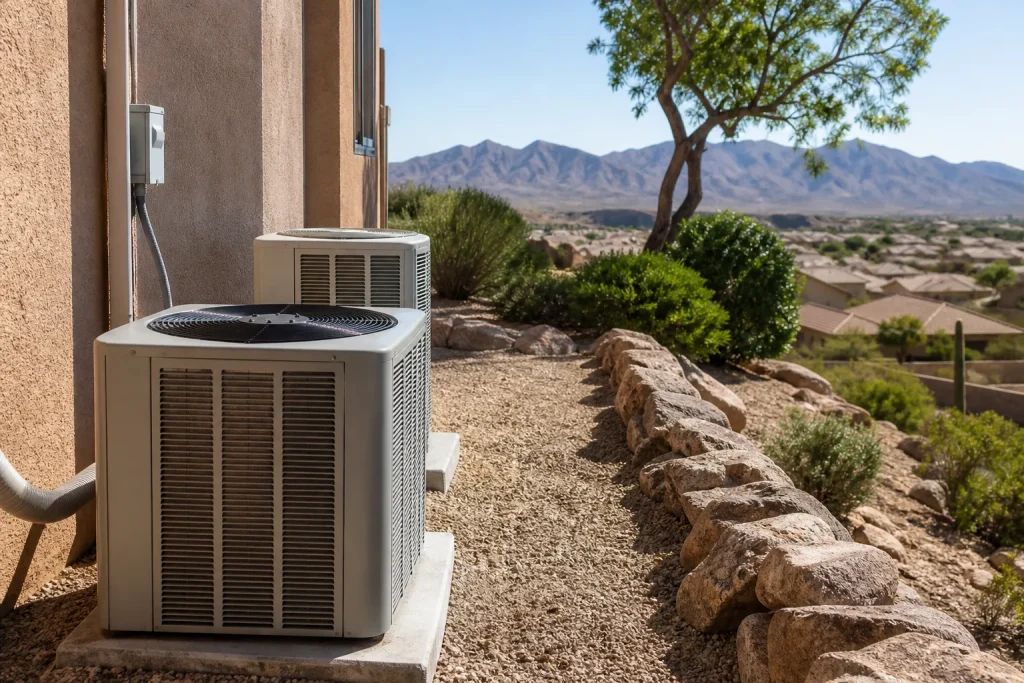
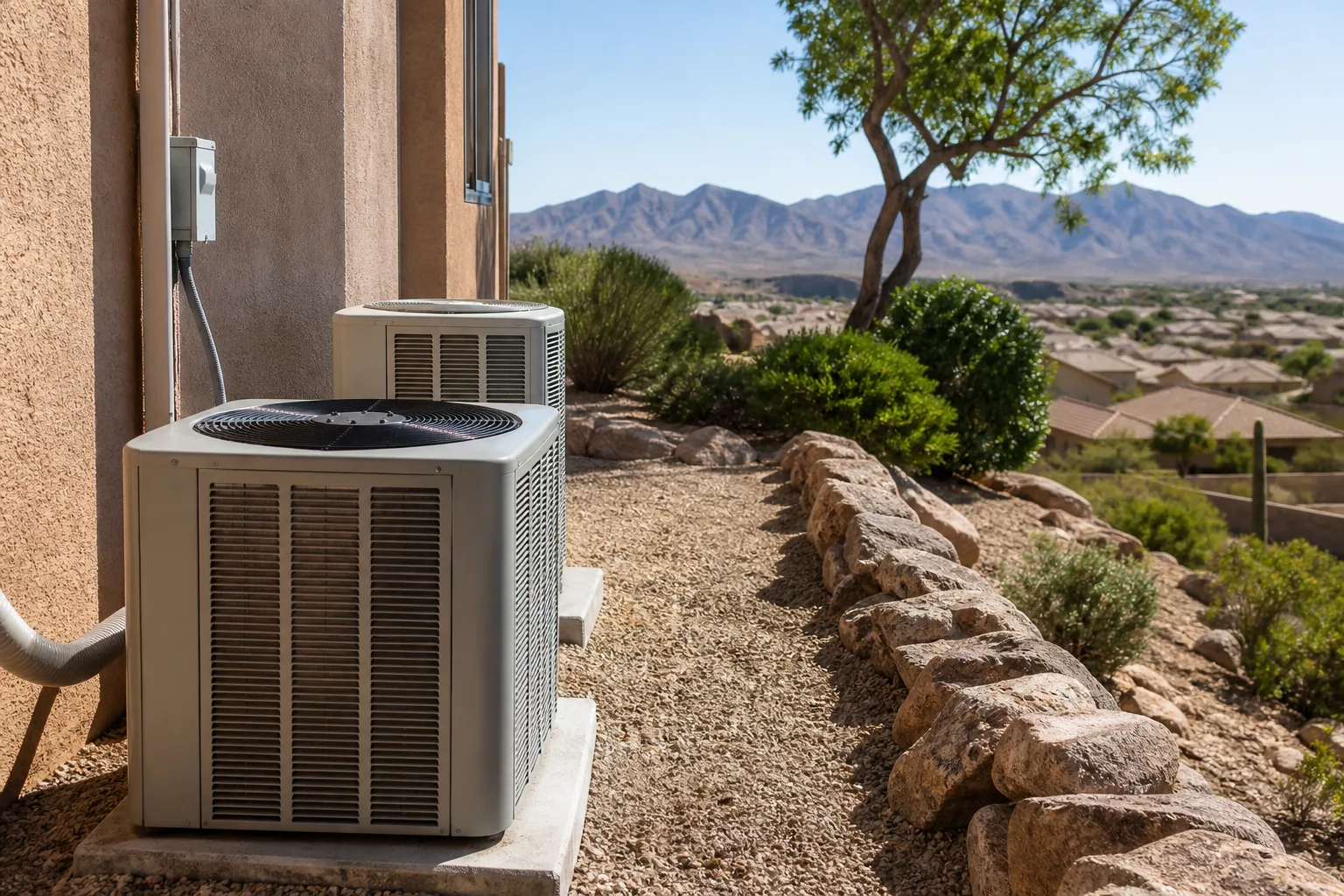
Heat Pump & Mini Split: Repair or Replace? How Boulder City Homeowners Decide
Mini splits don’t have the 15-year track record in Boulder City’s heat that central systems do, so the repair-or-replace math here is genuinely harder. Anyone who gives you a confident answer before they’ve looked at the system is guessing. The short version: replace when a single repair costs more than 40% of a new system, when the compressor or reversing valve has failed on a unit past 10 years, or when refrigerant leaks keep coming back after two sealed repairs. Repair when the fault is a board, a fan motor, or a clogged drain line on a system still inside its useful life. If you’d rather have a trained eye on it than sort through it alone, call (844) 312-0133.
Why mini split decisions are harder than central system decisions
A central split system gives you a fairly clean ratio to work with: if the compressor is shot and the unit is 12 years old, you replace it. Mini splits muddy that because the parts economics are different, and the lifespan data is still catching up. Compressors on mini splits tend to cost a larger share of the system price than they do on a central condenser, which pushes more repairs toward the replace line. At the same time, a mini split has fewer moving parts overall, so a healthy unit can run longer than a comparable central system in the same conditions.
What we’ve seen working in Boulder City is that a head unit with a failed control board at year six is almost always worth fixing. A failed compressor at year eleven on the same equipment is not. The line sits somewhere in between, and it moves based on how hard the system has worked. A single-zone mini split cooling one bedroom in a well-shaded house lives an easier life than a three-zone system carrying a whole west-facing home through July.
One more thing that trips people up: a mini split that’s “still running” is not the same as a mini split that’s running efficiently. A unit low on refrigerant can cool the room while it quietly wears out the compressor. That’s why the number on the repair estimate matters less than what the technician found underneath it.
How Boulder City’s temperature swings stress reversing valves
Boulder City is not a purely hot climate, and that distinction matters more for heat pumps and mini splits than it does for straight air conditioning. Desert days climb hard, then the nights drop fast. In spring and fall that swing happens daily, and the reversing valve on a heat pump or mini split cycles between heating and cooling far more often than it would in a climate that stays in one lane.
The reversing valve is the part that lets a heat pump switch between heating and cooling, and it is the single most expensive repair on most mini split systems after the compressor. Frequent switching is hard on it. We pulled a valve on a unit over in the Historic District last spring that had cycled so many times the slide was scored – the homeowner had assumed the system was fine because it still heated, right up until it didn’t.
- Cold mornings after hot afternoons push the valve through more reversals in a week than a mild climate sees in a month.
- Dust and debris from desert wind work into outdoor coils and force the system to run longer and hotter to hit the same setpoint.
- Hard water and mineral dust on condensate lines cause clogs that show up as water stains, not as cooling problems – easy to miss, easy to fix early.
- Voltage sag on hot afternoons when the neighborhood draws hard is rough on inverter boards, which are the second most common expensive failure we see on mini splits in Boulder City.
If your system is cycling between heat and cool most of the year, expect the reversing valve to be the part that decides repair or replace for you.
The age-and-symptom combinations that tell you it’s time
Age alone doesn’t decide it. Age plus a specific symptom does. Here are the combinations we treat as end-of-economic-life signals on a mini split in a desert climate:
- 10+ years and a refrigerant leak that has come back after two sealed repairs. Repeated leaks usually mean the coil or the line set is failing from the inside, and chasing it further is money down a hole.
- 8+ years and a failed compressor. On a mini split, a compressor replacement runs high enough that you’re most of the way to a new unit before labor.
- 7+ years and a failed inverter board on a brand with limited parts availability. The board itself might be affordable, but if it takes three weeks to source, you’ve already made the decision.
- Any age and visible corrosion on the outdoor coil fins from salt air or dust packing. A corroded coil can’t be repaired – only replaced – and a coil replacement on an older unit rarely pencils out.
- Any age and a system that has never been serviced with a compressor that’s now drawing high amps. That’s a compressor on its way out, not a system worth investing in.
On the other side, these are reliably worth repairing: a failed fan motor, a clogged condensate drain, a control board on a unit under seven years, a stuck louvers motor, or a system that just needs a refrigerant top-off after a slow leak that was found and sealed once. Those are all inside the “fix it” zone.
Multi-zone systems: when one head fails, what happens to the rest
This is where most homeowners get stuck, and where a lot of bad advice gets handed out. On a multi-zone mini split, each indoor head has its own metering and controls, but they all share one outdoor condenser and one refrigerant circuit. That means the health of the outdoor unit governs the whole system, and a problem in one head can be a symptom of something in the condenser that affects all of them.
- If one head fails and the outdoor unit is healthy and under 10 years: repair or replace that head individually. You don’t need to replace a working system to fix one zone.
- If one head fails and the outdoor unit is past 12 years or already had a compressor or valve repair: that failure is a warning about the condenser, not just about the zone. Price the whole system before you commit to a single-head fix.
- If two or more heads fail within a year of each other: that’s a condenser problem, not a coincidence. Replace the system.
- If you’re adding a zone to an older system: the new head may not be compatible with the older condenser, and mismatched refrigerant types (R-22 vs. R-410A vs. the newer R-454B) can force a full replacement anyway.
What to ask a technician to document on a repair visit
Whatever you decide today, you want a written baseline for the next decision. Ask the technician to write down and hand you:
- The model and serial number of the outdoor unit and each indoor head, so you know exactly what you own and its manufacture date.
- The refrigerant pressures and superheat/subcool readings at the time of service, so the next technician has a comparison point.
- The compressor amp draw against nameplate rating.
- Any signs of coil corrosion, oil staining near joints, or valve scoring.
- The repair performed, the parts used, and the parts warranty terms in writing.
We hand every customer a written summary at the end of a repair for exactly this reason. When the next decision comes, you’re not starting from zero. That written record is also what the 90-Day Done Right Promise is built on: if the repair doesn’t hold, we make it right, in writing, no arguing.
Repair or replace: how the cost math shakes out
Here’s a plain guide to how the numbers usually fall in Boulder City. Exact pricing depends on the system, but these are the ranges that move a decision from repair to replace.
| Repair type | Typical share of new system cost | Verdict |
|---|---|---|
| Fan motor, drain line, control board | Under 15% | Repair |
| Refrigerant leak found and sealed once | 15-25% | Repair, document it |
| Reversing valve replacement | 30-45% | Repair if under 8 years, replace if older |
| Compressor replacement | 50%+ | Replace in almost all cases |
| Indoor coil replacement (multi-zone) | 30-50% | Repair if condenser is healthy, replace if not |
A good rule of thumb: if a single repair costs more than 40% of a new system and the equipment is past 8 years, replace. Below that threshold, repair. Between 30 and 40%, the age and the history decide it. That’s the math we walk through with customers on a free second opinion of any written estimate, and we’ll tell you straight when replacement is the better call and when it isn’t.
When to call a pro: anything involving refrigerant, the compressor, the reversing valve, or the electrical panel. Those are not homeowner jobs, and the refrigerant handling alone requires licensing and equipment. A failed mini split can also mean a home without heat on a cold night, which for older homeowners is a genuine health concern, not a comfort issue. We answer the phone around the clock, a live person every time, including the 2 a.m. call.
The Bottom Line
In Boulder City, mini split repair-versus-replace comes down to five things: the age of the outdoor unit, whether the failure is compressor or valve versus a board or motor, whether a refrigerant leak has come back, whether the system is multi-zone with a failing condenser, and whether you have a written record from the last service to compare against. Repair when the fault is affordable and the equipment is young. Replace when the repair cost crosses 40% of new on a system past 8 years, or when the compressor or reversing valve has failed on an older unit.
If you’re in Boulder City and need help, Fireside Heating & Air Co. Boulder City offers free estimates – call (844) 312-0133. Our technicians have up to 8 years of experience, we service nine major brands including Carrier, Trane, Lennox, and American Standard, and every repair comes with upfront pricing: the price quoted is the price paid. Standing offers include $50 off any repair over $250, a free second opinion on any written estimate, an $89 seasonal tune-up, and a Senior and Veteran 5% discount, always. We will be there when we say.
Frequently Asked Questions
How long does a mini split last in Boulder City?
A well-maintained mini split in Boulder City typically runs 10 to 15 years, with the shorter end of that range common on multi-zone systems that see heavy daily use and temperature swings. Systems that get an annual tune-up and have their coils cleaned tend to reach the upper end.
Is it worth repairing a mini split with a bad compressor?
Rarely. A compressor replacement on a mini split runs high enough that you’re most of the way to a new system in cost, and you still have the rest of an aging system around it. On a unit under five years with a manufacturing defect, that’s a warranty conversation; on a unit past eight years, replacement is usually the better call. Call (844) 312-0133 if you want a second opinion on the estimate in writing.
Can you repair just one zone on a multi-zone mini split?
Yes, if the outdoor condenser is healthy and under ten years old. Each indoor head has its own metering and controls, so a single failed head can be repaired or replaced on its own. If the outdoor unit is past twelve years or has already had a major repair, price the full system before committing to one zone.
Should I get a second opinion before replacing my mini split?
Yes, always. Free second opinions on any written estimate are one of our standing offers, and we’ll tell you plainly whether the repair is worth doing or whether replacement is the right move. A written second opinion takes a few minutes on the phone and can save you thousands. Call (844) 312-0133 to set one up.
What’s the difference between a heat pump and a mini split?
A mini split is a type of heat pump – a ductless heat pump with one or more indoor heads. Both heat and cool, both run on the same reversing-valve principle, and both are subject to the same repair-versus-replace math. For a deeper look at how these systems work, see our Heat Pump & Mini Split in Boulder City page.
Related services in Boulder City: for central system issues, see AC Repair & Installation in Boulder City; for heating and furnace questions, see Heating & Furnace in Boulder City. For everything else, start at the Fireside Heating & Air Co. Boulder City home page.
Written by the team at Fireside Heating & Air Co. Boulder City.
Need HVAC Help?
Call Fireside Heating & Air Co. Boulder City - licensed & insured, here with fast after-hours help in Boulder City.
(844) 312-0133