
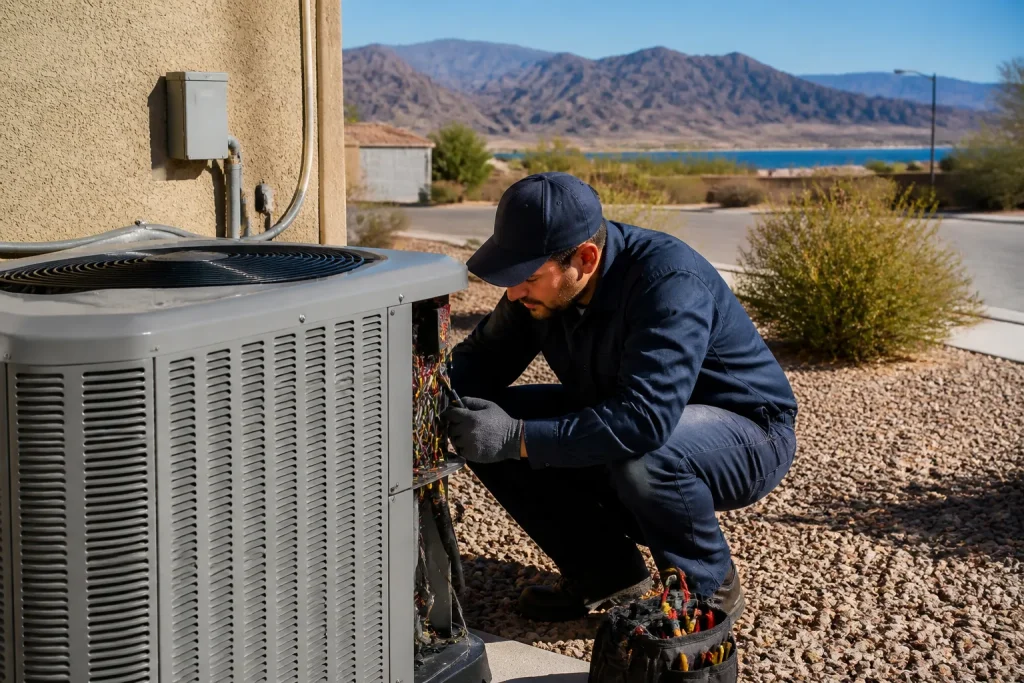
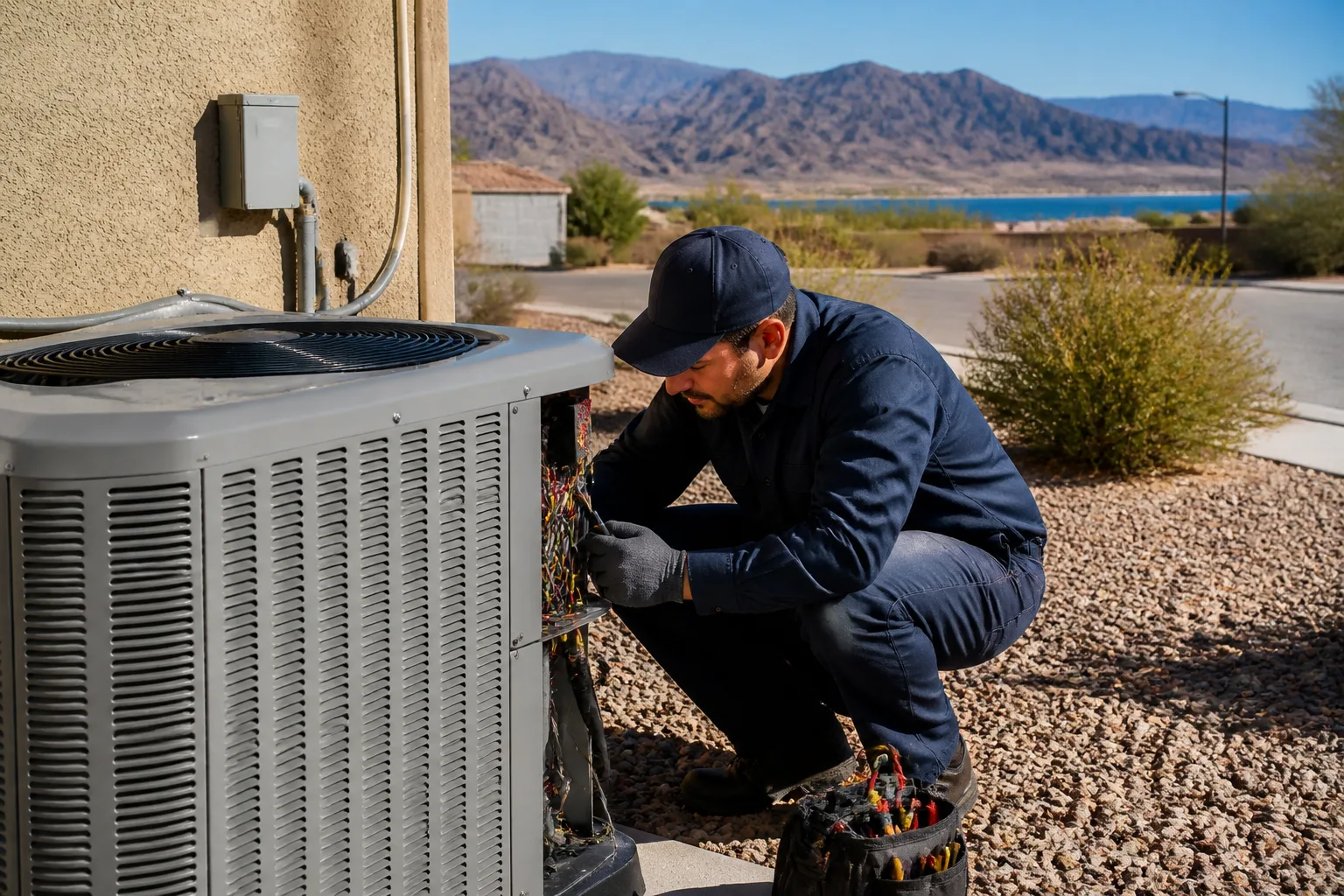
Top Signs You Need HVAC Service – Don’t Ignore These
Most HVAC warning signs don’t announce themselves. They show up as a dollar-a-day bump in your electric bill, or a temperature swing you’ve trained yourself to ignore. By the time a system quits in August, the damage that could have been a $200 fix has become a compressor replacement. Here in Boulder City, the warning signs hide in plain sight – and the quickest place to catch them is your NV Energy bill.
Your Electric Bill Is the First Warning Sign
A Boulder City homeowner’s electricity bill tells you more about system health than any noise or thermostat reading. Heat and cooling performance is the one part of your usage you can actually improve, and a system losing efficiency will show up in the meter long before it shows up in the air.
Here’s a practical way to use it. Pull three consecutive NV Energy bills from the same season and compare the kilowatt-hour usage, not the dollar amount – rates and fees shift, but kWh is steady. A jump of 10% or more from month to month with no change in your habits (no extra guests, no new appliance) is the signal to call. Below that, normal weather stress explains most of it. Above 15% and climbing each month, we start expecting to find a dirty condenser coil, a refrigerant charge that’s drifted low, or a blower motor drawing harder than it should.
We’ve seen this play out across Boulder City for decades. The homeowner calls in May because February, March, and April all rose in a neat line. Replacing the condenser coils takes a modest repair budget. Ignoring the trend until July, when the bill doubles and the system freezes up trying to keep up, means a different conversation altogether.
A 15% climb over three months is a service call. A one-month spike usually isn’t.
Anyone comparing costs can check their own history in the NV Energy app in under two minutes. We’re happy to look at the same numbers with you and tell you what we think is happening before we ever send a truck.
Short-Cycling Is a Compressor Distress Signal, Not a Thermostat Quirk
Short-cycling is the system turning on, running a moment, and shutting off again – over and over. In Boulder City heat, that pattern almost always means the system is struggling, not that your thermostat is misbehaving.
A compressor that can’t complete a normal cycle is straining against one of a few things: low refrigerant, a failing capacitor, a clogged filter choking airflow, or a compressor that’s simply overheating in 110°F conditions. Each of those has a different repair price, and one of them – the overheating compressor – is the difference between a few hundred dollars and a full replacement. Running a system through short cycles accelerates that wear fast.
What you’ll practically see when short-cycling is happening:
- It runs several minutes, stops, restarts, then repeats – a distinct rhythm
- Indoor temperatures never quite catch up even though the system is running constantly
- A warm supply from your vents then a cold one a moment later
If you spot that cycle in a Boulder City home, don’t chalk it up to desert heat. It’s one of the more common calls we get and one of the most rewarding to catch early. Straight talk about repair versus replace starts with knowing which part is actually failing.
Uneven Room Temperatures Say a Lot About Your Ducts
When one room runs several degrees hotter than the rest, homeowners often assume the AC is too small. In Boulder City homes built for desert conditions, the equipment is usually doing its job. The real problem is often the ductwork.
Air leaks, disconnected sections, crushed flex runs, or registers that were never balanced properly bleed cool air into the attic or garage instead of into the room. Older construction in this region makes it worse – long attic runs bake in the summer sun and lose cold air on the way to the thermostat. A room that’s always 8°F off isn’t a capacity problem unless the equipment itself tests weak.
The way to tell the difference: if the system is clean, charged, and blowing full volume at the air handler while one room stays warm, the air isn’t reaching the room. That’s a duct issue, not an AC issue. We’ve found one such home in Boulder City where a single collapsed attic run was stealing the lion’s share of the cold air – a duct repair fixed what the homeowner thought was a failing unit.
If you’d like us to check the whole system, we handle AC Repair & Installation in Boulder City and can tell you plainly whether the fix is ductwork or hardware.
What Sound Is Your System Making Right Now?
Two common sounds mean very different repairs. A failing capacitor usually produces a quiet clicking that repeats on each restart attempt, sometimes paired with the compressor trying and failing to turn over. A failing contactor typically sounds like a sharper, sharper chatter or buzzer at the start of a cycle – a distinct, harder clicking you can hear from another room. One is a relatively inexpensive part. The other needs the electrical controls checked before the compressor burns itself out from frequent attempts.
Listen on a calm evening. Turn the system on and pay attention to the outdoor unit for a minute. Any new chatter, click, or buzz that wasn’t there last season is worth a look, especially in a Boulder City home where the unit runs most of the day in summer.
When to call a pro
If you hear repeated clicking or grinding, turn the system off at the thermostat and call. An electrical control fault or a failing compressor can damage other parts, and a $200 repair can become a much larger one the longer it runs in distress. Our technicians have up to 8 years of experience identifying these issues, and every job is backed by our 90-Day Done Right Promise – if it isn’t done right, we make it right, no arguing.
Ice on the Refrigerant Line Is a Charge Problem, Not a Sign the Unit Is Working Hard
Ice on a refrigerant line in 110°F heat isn’t a good sign that the house is cooling well – it’s the opposite. That line shouldn’t be cold enough to frost. Ice build-up means the refrigerant charge has dropped too low, the evaporator coil is starving for air, or the airflow is choked. The system is working harder than it should and moving less cool air, not more.
In Boulder City, this is one of the most commonly misread symptoms. Homeowners take the ice as reassurance and let it run. All the while the compressor is overheated and the coil grinds through the summer. By the time the indoor temperatures climb and the system quits, what would have been a refrigerant leak repair has escalated into compressor damage.
What we check when ice forms on the refrigerant lines
We check airflow first (filter, blower, indoor coil) and then the refrigerant charge. If the coil is dirty, we clean it. If the charge is low, we find and fix the leak rather than top it off. This approach saves homeowners unnecessary replacements and keeps the same problem from coming back.
For heat pumps and mini-splits working year-round in Boulder City, the same rules apply – we handle Heat Pump & Mini Split in Boulder City and can check the charge and controls on the same visit.
Why Desert Climates Make Every Warning Sign More Urgent
Boulder City’s swings are hard on a system. Summer highs run near 110°F, and winter nights drop into the 30s. That’s a system that cycles through extremes most of the year. UV exposure degrades wiring and insulation on outdoor units. Dust and fine grit find their way into coils and blower housings. All of these push a system toward failure faster than homeowners expect, and they make early warning signs worth more.
The good news is that most of what we described here is caught with routine service. A flat-price seasonal tune-up with a written report of what we found is the cheapest insurance against an August failure. We’ll tell you what’s actually going on and what we found – no upselling, no pressure. Our technicians aren’t paid on what they sell.
If you’re spending summer in Boulder City and your heating or cooling needs attention, we handle Heating & Furnace in Boulder City the same way.
The Bottom Line
Most HVAC failures give you warning – it’s just quieter than we hope. Watch your NV Energy bill for a 10%+ climb over consecutive months. Treat short-cycling as a compressor signal, not a thermostat quirk. Uneven rooms point to ducts. Ice means a charge problem. And a new click or chatter warrants a look before it costs more than it should.
If you’re in Boulder City and need help, Fireside Heating & Air Co. Boulder City offers free estimates – call (844) 312-0133. We answer in person, 24 hours a day, and the price we quote is the price you pay. See the team and services at our Fireside Heating & Air Co. Boulder City home.
Frequently Asked Questions
A standard diagnostic service call for AC or heating problems typically costs $89 – $150, and a flat-rate seasonal tune-up is $89. The $89 tune-up includes a written report of what we found. Call (844) 312-0133 for an exact quote – estimates are free. If repair work is needed and totals over $250, we take $50 off, and a free second opinion is available on any written estimate.
Short-cycling is the system turning on and off in rapid intervals instead of running a full cycle. In Boulder City it usually points to low refrigerant, a failing capacitor, or a clogged filter – not a thermostat problem. Left alone, it wears out the compressor. Turn the system off and have it checked.
No. Ice on a refrigerant line at 110°F means a low refrigerant charge, restricted airflow, or a dirty coil – not that the system is working extra-hard. Turn the unit off at the thermostat and call us. Leaving it running can cause expensive compressor damage.
Yes. We’re trained to service nine major brands, including Carrier, Trane, Lennox, American Standard, Goodman, Rheem, York, Daikin, and Bryant, and most repairs are completed in a single visit. Free second opinions are available on any written estimate. Call (844) 312-0133 for a free estimate.
Written by the team at Fireside Heating & Air Co. Boulder City.
Need HVAC Help?
Call Fireside Heating & Air Co. Boulder City - licensed & insured, here with fast after-hours help in Boulder City.
(844) 312-0133